NHS Retirement Age Guide: Find Your Exact Pension Age & Max Benefits
Discover when you can retire from the NHS, how your pension works, and simple ways to maximise your retirement income.
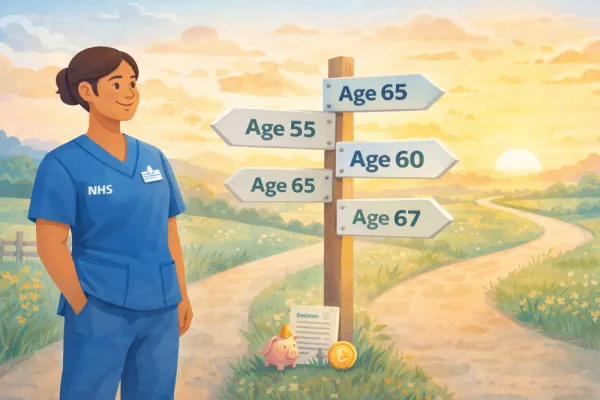
If you work for the NHS, you already know that the job can be demanding. Long shifts, emotional pressure, and years of dedicated service all add up. So when it comes time to think about retirement, you deserve clear answers - not a maze of jargon and confusing rules.
That’s exactly what this NHS retirement age guide is here to do. Whether you’re a nurse, a porter, a consultant, or an admin worker, we’ll walk you through everything: when you can retire, which pension scheme you belong to, how much you might get, and how to squeeze every last penny out of your benefits. Think of your NHS pension like a plant you’ve been watering for decades - this guide helps you harvest it at just the right time.
What Is the NHS Pension Scheme?
The NHS Pension Scheme is one of the best workplace pensions in the UK. It’s a defined benefit scheme, which means your retirement income is based on a formula rather than how the stock market performs. You don’t need to worry about picking investments or watching fund values go up and down.
Every month, a percentage of your salary is automatically taken before tax and paid into the scheme. Your employer - the NHS - also pays a significant contribution on your behalf. When you retire, you get a guaranteed income for life, plus the option to take a tax-free lump sum. For many NHS workers, this pension forms the backbone of their retirement income, often alongside the State Pension.
The key takeaway? Your NHS pension is incredibly valuable. It’s inflation-protected, it pays out for life, and it’s backed by the government. Very few private sector pensions offer anything close.
Which NHS Pension Scheme Are You In?
This is where things get a bit tricky, because the NHS pension hasn’t always worked the same way. Over the years, there have been three main sections, and which one you’re in depends on when you started working for the NHS.
The 1995 Section was a final salary scheme that closed to new members on 31 March 2008. If you were in this section, your pension is based on your final salary when you leave or retire. The normal pension age here is 60, and you earned pension at a rate of 1/80th of your final salary for each year of service. You also got an automatic lump sum worth three times your annual pension.
The 2008 Section opened on 1 April 2008 and was also a final salary scheme, but with a normal pension age of 65. The accrual rate was better - 1/60th of your reckonable pay per year of service - but there was no automatic lump sum. You could, however, choose to exchange some pension for a cash lump sum.
The 2015 Scheme is the current scheme that all active NHS members now belong to, following changes that took effect on 1 April 2015. This is a career average scheme, not a final salary one. Your pension builds at 1/54th of your pensionable pay each year, and those amounts are revalued annually in line with inflation plus 1.5%. The normal pension age is linked to your State Pension age.
Not sure which section applies to you? You can check your annual benefit statement or log in to your My NHS Pension account through the NHSBSA website. You might also want to use the NHS Pension Calculator to estimate your benefits across different schemes.
What Is Your Normal Pension Age?
Your normal pension age is the age at which you can take your full NHS pension without any reductions. It varies depending on which scheme section you belong to:
1995 Section members have a normal pension age of 60. If you have Special Class status or Mental Health Officer status, it could be even earlier - as young as 55.
2008 Section members have a normal pension age of 65.
2015 Scheme members have a normal pension age that matches their State Pension age. For most people currently in their 40s or 50s, this is 67. But keep in mind that the State Pension age is rising - it’s set to move from 66 to 67 between April 2026 and March 2028, and a further increase to 68 is legislated for 2044 to 2046.
If you’ve got benefits spread across more than one section (which is common if you’ve worked in the NHS for a long time), each chunk of your pension may have a different normal pension age. You can use the Retirement Age Calculator or the State Pension Age Calculator to work out exactly where you stand.
How Is Your NHS Pension Calculated?
The way your pension is worked out depends entirely on which scheme you’re in.
For 1995 Section members, the formula is straightforward: years of service divided by 80, multiplied by your final pensionable salary. So if you worked for 30 years and your final salary was £40,000, your annual pension would be £15,000 (30/80 × £40,000). On top of that, you’d get a lump sum of £45,000 (three times the pension).
For 2008 Section members, the formula uses 1/60th instead of 1/80th, and your pay is calculated as the average of your best three consecutive years in the last ten. Using the same example - 30 years of service with a salary of £40,000 - your pension would be £20,000 per year (30/60 × £40,000). No automatic lump sum here, but you can trade some pension for cash.
For 2015 Scheme members, each year you earn 1/54th of that year’s pay as pension. Those yearly amounts are then revalued each year by CPI plus 1.5%. The total of all those revalued amounts becomes your annual pension at retirement. It’s a bit more complex to calculate by hand, which is why using a pension calculator is so helpful.
Can You Retire Early from the NHS?
Yes, you can - but it comes with a cost. If you retire before your normal pension age, your pension is reduced to account for the fact that it’ll be paid out over a longer period. This is called an actuarial reduction, and it’s roughly 5% for each year you retire early, though the exact figure depends on your age and scheme section.
The minimum age you can take your NHS pension is currently 55. This applies to all scheme sections. However, the government plans to raise the minimum pension age to 57 from April 2028. If you joined the 1995 Section before 6 April 2006, you might be able to retire as early as 50, but this is increasingly rare.
Here’s the thing - early retirement reductions are permanent. They don’t go away once you reach your normal pension age. So if you’re considering stepping away early, it’s worth running the numbers carefully. The NHS Early Retirement Calculator can show you exactly how much your pension would be reduced.
Is it worth it? That depends entirely on your personal situation. If you have other savings, a partner’s income, or simply can’t continue working, early retirement might make perfect sense. But go in with your eyes open.
What Happens If You Retire Late?
On the flip side, if you keep working past your normal pension age without taking your pension, you earn what are called late retirement factors. These increase your pension by roughly 5% for each year you delay. That’s a pretty generous bonus for staying on.
You’ll also keep building up more pension during those extra years. Your salary may be higher, which means bigger annual additions to your career average pot (if you’re in the 2015 Scheme). Plus, you’ll continue earning towards your State Pension if you haven’t yet reached that age.
Delaying retirement isn’t for everyone, but if you enjoy your work and are in good health, the financial rewards can be substantial.
Understanding the State Pension Age Connection
This is a crucial piece of the puzzle, especially if you’re in the 2015 Scheme. Your normal pension age under the 2015 Scheme is pegged to the State Pension age, which is currently changing.
Right now, the State Pension age is 66 for both men and women. Starting from 6 April 2026, it begins to gradually rise to 67, affecting people born between April 1960 and March 1961. By 2028, it’ll be 67 for everyone in that cohort. A further increase to 68 is planned for between 2044 and 2046.
Why does this matter for your NHS pension? Because if the State Pension age goes up, your normal NHS pension age under the 2015 Scheme goes up with it. That means you’d need to work longer - or accept a bigger early retirement reduction - to access your full benefits.
You can check your personal State Pension age with the Pension Age Calculator, and don’t forget to check how much State Pension you might receive using the State Pension Calculator. Your NHS pension and State Pension together will form the bulk of your retirement income.
NHS Pension Contribution Rates Explained
Your contributions to the NHS pension are calculated on a tiered basis. The more you earn, the higher the percentage you pay. As of the current rates, contributions range from 5.1% of your pensionable earnings (for the lowest earners) up to 13.5% for the highest earners.
The good news? These contributions are taken before tax, which means you get immediate tax relief. If you’re a basic rate taxpayer, every £100 you put in only costs you about £80 in real terms. For higher rate taxpayers, the savings are even greater.
Your employer also pays a hefty contribution - typically around 20% of your pensionable pay. That’s money you never see in your payslip, but it’s working hard behind the scenes to fund your retirement benefits. When you add it all up, the total going into your pension pot each year is substantial, which is part of what makes the NHS pension so valuable.
If you want to understand how pension tax works for NHS employees specifically, you might find the NHS Tax Calculator or the HMRC Pension Tax Calculator useful.
Partial Retirement: The Best of Both Worlds
Here’s something many NHS workers don’t realise: you don’t have to go from full-time work to full retirement in one step. The NHS Pension Scheme offers partial retirement (also known as drawdown), which lets you take some of your pension benefits while continuing to work.
From age 55, you can draw between 20% and 100% of your pension benefits in up to two drawdown payments - all without having to leave your job. You could reduce your hours, step down to a less demanding role, and top up your income with pension payments.
The benefits are significant. The portion of your pension you draw early will be reduced if you’re below your normal pension age. But the portion you leave untouched continues to grow and will be paid at the full rate when you eventually retire completely. Meanwhile, you keep building up new pension benefits in the 2015 Scheme on whatever salary you’re still earning.
This flexibility is especially helpful for people who want to wind down gradually rather than stopping all at once. It’s worth noting that you need to have a break of at least 24 hours from your job to take your full pension benefits, but partial retirement has no such requirement.
How to Maximise Your NHS Pension Benefits
Getting the most out of your NHS pension isn’t just about working the longest time possible. There are several strategies worth considering.
Fill any gaps in your record. If you’ve had career breaks, periods of part-time work, or spells outside the NHS, check whether buying additional service or making Additional Voluntary Contributions (AVCs) could boost your pension. The Employer Pension Contribution Calculator can help you understand the full picture of contributions.
Consider an ERRBO. If you’re in the 2015 Scheme and your normal pension age is 67 or 68, you can buy an Early Retirement Reduction Buy Out. This lets you retire at 65 or 66 without any penalty. The cost depends on your age when you start paying, so the earlier you begin, the cheaper it is.
Think about salary sacrifice. Some NHS trusts offer salary sacrifice arrangements that can save you money on National Insurance contributions while still maintaining your pension benefits.
Don’t forget your lump sum options. Under the 1995 Section, you get an automatic lump sum. Under the 2008 Section and 2015 Scheme, you can exchange some pension for a tax-free lump sum. Whether this makes sense depends on your tax situation and how much income you need in retirement.
The McCloud Remedy and What It Means for You
If you were in the NHS Pension Scheme on 31 March 2012 and were moved to the 2015 Scheme on 1 April 2015, you may be affected by the McCloud remedy. This was a legal case that found the government’s transitional protections - which allowed older members to stay in the legacy schemes - were age discriminatory.
As a result, affected members will be given a choice: for the period between 1 April 2015 and 31 March 2022 (known as the “remedy period”), you can pick whether you want your benefits calculated under your old scheme (1995 or 2008 Section) or the 2015 Scheme. The NHSBSA will calculate both options when you come to retire, so you can see which gives you a better deal.
You don’t need to do anything right now - the choice will be presented to you at retirement. But it’s helpful to understand that this safety net exists, especially if you were unhappy about being moved to the 2015 Scheme. The CETV Calculator and Final Salary Pension Transfer Value Calculator can help you compare the value of benefits under different schemes.
Tax-Free Lump Sums at Retirement
One of the most attractive features of the NHS pension is the ability to take a chunk of your benefits as a tax-free lump sum when you retire.
Under the 1995 Section, you automatically receive a lump sum equal to three times your annual pension. You can also give up some extra pension to increase this lump sum further.
Under the 2008 Section and 2015 Scheme, there’s no automatic lump sum. However, you can choose to exchange part of your pension for a tax-free cash payment. The exchange rate is typically around £12 of lump sum for every £1 of annual pension you give up.
Whether you should take a lump sum or keep the higher pension depends on your circumstances. If you have debts to clear, want to help family members, or need a financial cushion for the early years of retirement, the lump sum can be a lifesaver. If you’re focused on maximising your guaranteed income for life, keeping the full pension might be the smarter move. The Pension Lump Sum Tax Calculator can help you model the tax implications.
What Happens If You Leave the NHS?
Life happens. Maybe you want a career change, maybe you’re moving abroad, or maybe you just need a break. Whatever the reason, leaving the NHS doesn’t mean you lose your pension.
Your benefits become deferred, which means they’re frozen in the scheme and continue to be revalued until you reach your normal pension age. When you’re ready, you can claim them just like any other NHS pension. In most cases, this is the best option because the NHS pension’s guaranteed benefits, inflation protection, and death benefits are extremely hard to replicate elsewhere.
You can also transfer your NHS pension to another scheme, but this is rarely recommended. Financial advisers almost universally suggest keeping your NHS pension where it is. A transfer involves giving up guaranteed, inflation-linked benefits in exchange for an uncertain pot of money, and the risks are significant.
If you return to the NHS later, you’ll automatically rejoin the 2015 Scheme and start building up new benefits alongside your deferred ones. The Retirement Date Calculator can help you plan around any breaks in service.
How to Check Your NHS Pension Statement
You should be receiving an annual benefit statement from the NHSBSA, which shows your current pension entitlement, projected benefits at retirement, and contribution history. If you haven’t been getting these, it’s worth chasing them up.
The easiest way to check is through the My NHS Pension portal on the NHSBSA website. You can log in, view your records, and even run retirement estimates. If you’re planning to retire soon, you should request a formal pension estimate at least 12 months in advance.
Your statement will show benefits under each scheme section you belong to, which is important if you’ve been in the NHS long enough to span more than one. For a broader view of your retirement finances, you might also check your State Pension forecast and use the Take Home Pay Calculator to understand how your finances will change once you stop working.
Planning Your NHS Retirement: A Step-by-Step Checklist
Retirement planning doesn’t happen overnight. Here’s a practical breakdown of what to do and when.
Five years before retirement, start getting serious. Request your annual benefit statement, check your State Pension forecast, and think about whether you want to retire at your normal pension age or earlier. This is the time to explore options like ERRBOs or Additional Voluntary Contributions.
Two years before retirement, contact the NHSBSA for a formal pension estimate. Start thinking about your lump sum decision, and talk to your employer about your intended retirement date. If you’re considering partial retirement, discuss your options for reduced hours or a different role.
One year before retirement, your employer should give you the AW8 retirement application form. Complete it as soon as you can. Make sure your personal details, bank account, and tax information are all up to date. Start thinking about what you’ll do in retirement - staying active and having a purpose matters just as much as money.
On retirement day, remember that if you’re taking your full benefits (not partial retirement), you need a break of at least 24 hours from NHS employment before your pension kicks in.
For a comprehensive overview of how pensions work in the UK, the Pension Explained Retirement Guide is a great place to start.
Conclusion
Navigating the NHS pension system doesn’t have to feel overwhelming. Yes, there are different schemes, varying pension ages, and a handful of complex rules. But at its core, this NHS retirement age guide boils down to a few simple truths: know which scheme you’re in, understand your normal pension age, and plan ahead so you don’t leave money on the table. Your NHS pension is one of the most valuable workplace benefits in the country - treat it that way.
Frequently Asked Questions
What is the normal retirement age for NHS workers?
It depends on your scheme section. For the 1995 Section, it’s 60 (or 55 with Special Class status). For the 2008 Section, it’s 65. For the 2015 Scheme, it matches your State Pension age, which is currently 66 and rising to 67 from April 2026.
Can I take my NHS pension at 55?
Yes, 55 is currently the minimum age you can access your NHS pension voluntarily. However, your benefits will be reduced because you’re taking them before your normal pension age. The minimum age is set to increase to 57 in April 2028.
How much is the NHS pension worth per year of service?
Under the 1995 Section, you earn 1/80th of your final salary per year. Under the 2008 Section, it’s 1/60th. Under the 2015 Scheme, it’s 1/54th of your pensionable pay each year, revalued annually by CPI plus 1.5%.
Will the NHS pension age go up in the future?
For members in the 2015 Scheme, your pension age is linked to the State Pension age. Since the State Pension age is rising to 67 from April 2026 (and planned to reach 68 between 2044 and 2046), your NHS pension age may increase too. You can check your personal position using a Pension Age Calculator.
Is it better to take a lump sum or a higher pension from the NHS?
There’s no one-size-fits-all answer. Taking a lump sum gives you immediate cash and tax-free money, but reduces your annual pension for life. If you’re in good health and expect a long retirement, keeping the higher pension often works out better financially. It’s worth using a Pension Lump Sum Tax Calculator and considering professional financial advice before deciding.
Posted 3 months ago by Jason