CFD Calculator
Calculate your CFD trading profit or loss, margin requirement, overnight funding costs, and Capital Gains Tax liability before you trade. Compare after-tax returns against spread betting — updated for 2026/27 UK CGT rates.
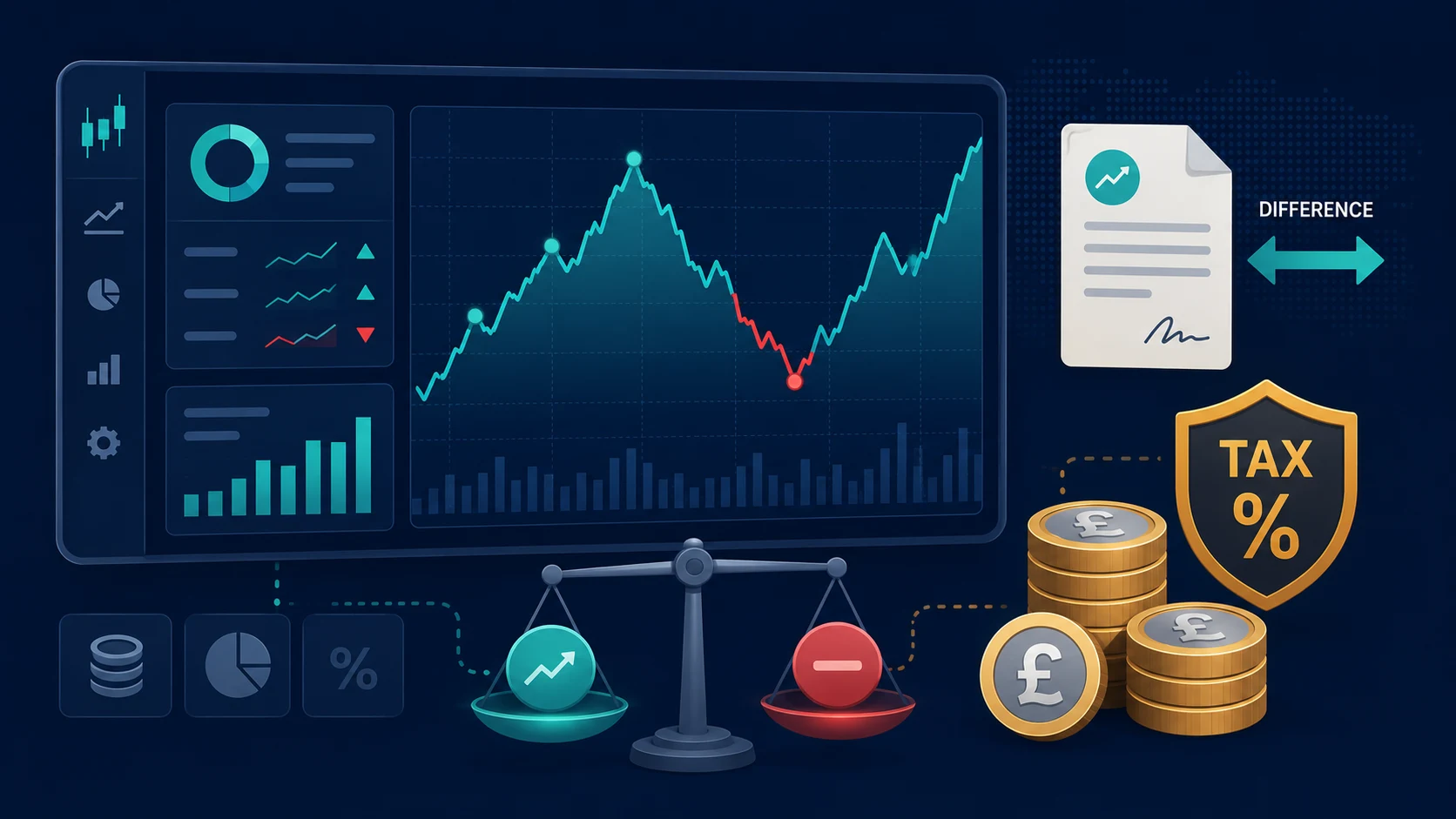
Understand Every Cost Before You Trade
CFDs involve multiple cost layers — spread, commission, overnight funding, and Capital Gains Tax. This calculator breaks down every element so you can see your true net profit after all costs and tax, and compare it against the tax-free alternative of spread betting.
CFD Calculator
CFD Trade Analysis
Gross Profit / Loss
£0
0 points moved
£0 per point
Risk at Stop Loss
—
Set a stop loss to see risk
R:R Ratio: —
Cost Breakdown
- Gross P&L:£0
- Spread Cost:-£0
- Commission (both sides):-£0
- Overnight Funding (0 days):-£0
- Total Costs:-£0
- Net Profit Before Tax:£0
Margin & Position
- Notional Exposure:£0
- Margin Rate (FCA retail):5%
- Leverage:20:1
- Margin Required:£0
- Margin % of Account:0%
- Account Risk at Stop:0%
Capital Gains Tax Estimate
- Net Profit (this trade):£0
- Other Gains:£0
- Losses Offset:-£0
- Annual Exempt (£3,000):-£0
- Taxable Gain:£0
- CGT Rate:18%
- CGT Due:£0
- Net Profit After Tax:£0
CFD vs Spread Betting Comparison
This CFD Trade
£0
After CGT and all costsSame Trade as Spread Bet
£0
Tax-free, after costs onlyTax Cost of Using CFD
£0
Extra tax paid vs spread bettingAbout This Calculation
This calculator uses FCA minimum margin rates for retail clients and 2026/27 CGT rates. Actual spreads, margins, and funding vary by broker and market conditions. Overnight funding uses an approximate 6.5% p.a. rate (SONIA + markup). For official CFD/spread bet rules, see FCA guidance. For CGT reporting, see HMRC Capital Gains Tax. For impartial advice, visit MoneyHelper.
How CFD Trading Works
A Contract for Difference (CFD) is a derivative that lets you speculate on price movements without owning the underlying asset. You profit from the difference between the opening and closing price, multiplied by your position size. CFDs use leverage, meaning both gains and losses are amplified relative to your margin deposit.
Profit & Loss
CFD profit equals: (Close Price - Open Price) x Units for long positions, reversed for short. A 50-point move on 10 contracts of the FTSE 100 gives £500 profit or loss. Your total trading costs — spread, commission, and overnight funding — are deducted from the gross result. The net profit is then subject to Capital Gains Tax.
For equivalent calculations on individual shares, use our Stock Trading Profit Calculator.
Costs: Spread, Commission & Funding
CFD costs come in three layers. The spread (buy/sell price difference) is your immediate entry cost. Commission applies mainly to share CFDs, typically 0.1% per side. Overnight funding is charged daily on positions held past the trading day close, usually SONIA + 2-3% per annum.
Overnight funding is deductible as an allowable cost against your CGT liability, reducing the tax impact of holding positions.
Tax: CGT with Loss Offsetting
CFD profits are subject to CGT at 18% (basic rate) or 24% (higher rate) above the £3,000 annual exempt amount. Unlike spread betting, CFD losses can be offset against gains from shares, property, or any other asset — a significant tax advantage for traders who don't win every trade.
Report gains via Self Assessment. For wider tax planning, see our HMRC Pension Tax Calculator.
FCA Margin Rates & Product Comparison
FCA Retail Margin Requirements
| Market | Margin | Leverage |
|---|---|---|
| Major Forex Pairs | 3.33% | 30:1 |
| Minor Forex / Gold / Major Indices | 5% | 20:1 |
| Commodities / Minor Indices | 10% | 10:1 |
| Individual Equities | 20% | 5:1 |
| Cryptocurrencies | Banned for UK retail clients | |
CFD vs Spread Bet vs Shares
| Feature | CFD | Spread Bet | Shares |
|---|---|---|---|
| CGT | 18% / 24% | Exempt | 18% / 24% |
| Stamp Duty | None | None | 0.5% |
| Losses Offsettable | Yes | No | Yes |
| Leverage | Yes | Yes | No |
| Ownership | No | No | Yes |
| ISA Eligible | No | No | Yes |
| Short Selling | Yes | Yes | Limited |
Key Considerations for CFD Traders
Self Assessment Reporting
You must report all CFD gains through Self Assessment, even if they fall within your £3,000 exempt amount, if total disposal proceeds exceed £50,000 in the tax year. Keep detailed records of every trade including dates, entry/exit prices, costs, and gains/losses. Your broker should provide an annual statement, but maintaining your own records is essential for tax reporting.
The 30-Day Rule
HMRC's 30-day bed and breakfast rule prevents selling a CFD at a loss and repurchasing the same instrument within 30 days to crystallise an artificial loss. The loss is deferred until the repurchased position is eventually closed. You can buy a different but similar instrument (e.g. a different index ETF) to maintain exposure while harvesting the loss.
50% Margin Close-Out
FCA rules require brokers to close out positions when your account equity falls to 50% of the total margin required. This protects against unlimited losses but may close your position at a worse level than your intended stop loss. Monitor your margin level continuously, especially during volatile markets. Negative balance protection ensures retail clients cannot lose more than the funds in their account.
Consider the Bigger Picture
Active CFD trading should be one component of a broader financial plan, not your entire strategy. Ensure your workplace pension contributions are on track, your emergency fund is in place, and your mortgage is manageable before allocating capital to leveraged trading. The 69-82% retail loss rate underscores the importance of not overcommitting to CFDs.
Frequently Asked Questions
CFD profit equals the difference between opening and closing price, multiplied by the number of units. For a long position: Profit = (Close - Open) x Units. For a short: Profit = (Open - Close) x Units. Trading costs (spread, commission, overnight funding) are deducted from the gross profit. The net result is then subject to CGT if profitable. For forex-specific calculations, use our Forex Profit Calculator.
CFD profits are subject to Capital Gains Tax at 18% (basic rate) or 24% (higher rate) above the £3,000 annual exempt amount for 2026/27. Losses can be offset against other capital gains or carried forward. Overnight funding charges are deductible as allowable costs. You must report gains via Self Assessment. No stamp duty applies to CFDs. For broader tax planning, see our Pension Tax Relief Calculator and Pension Lump Sum Tax Calculator.
Both are leveraged derivatives with identical FCA margin rules and consumer protections. The key difference is tax: spread betting is tax-free, CFDs are subject to CGT. However, CFD losses are offsettable against other gains, while spread betting losses are not. For consistently profitable UK traders, spread betting is superior. For those who frequently make losses, CFDs offer better tax efficiency through loss offsetting.
Use our Spread Betting Calculator for a direct side-by-side comparison on any trade.
FCA minimum margins for retail clients: 3.33% for major forex (30:1), 5% for minor forex/gold/major indices (20:1), 10% for commodities/minor indices (10:1), 20% for individual shares (5:1). Cryptocurrency CFDs are banned for UK retail clients. Margin = Units x Entry Price x Margin Rate. Your broker may require higher margins for specific instruments or during volatile conditions.
Overnight funding is a daily charge for holding CFDs past the end of the trading day (~10pm UK time). The rate is typically SONIA + a 2-3% broker markup per annum. For long positions, you pay funding. For short positions, you may receive a small credit (rare in the current rate environment). The daily charge is calculated as: Notional Value x Annual Rate / 365. Importantly, overnight funding charges are deductible as allowable costs against your CGT liability.
Yes — this is CFDs' key tax advantage over spread betting. Capital losses from CFDs can be offset against gains from shares, property, other investments, or any other chargeable assets in the same tax year. Unused losses can be carried forward indefinitely if registered with HMRC within 4 years. The 30-day bed and breakfast rule prevents artificial loss creation by selling and repurchasing the same instrument within 30 days.
Forex and index CFDs are typically commission-free — the broker profits from the spread. Share CFDs usually carry commission, typically 0.1% of the position value per side, with a minimum charge (often £10 per trade). Commission is charged on both opening and closing. For small share CFD trades, the minimum commission can be a significant percentage of the position — factor this into your profitability calculation before trading smaller equity positions.
Related Calculators
Know Your Numbers Before Every Trade
Successful trading starts with knowing your costs, risk, and tax position before you click the button. Use our full suite of trading and financial calculators to stay disciplined and informed.
Disclaimer
Risk Warning: CFDs are complex instruments and come with a high risk of losing money rapidly due to leverage. Between 69% and 82% of retail investor accounts lose money when trading CFDs. You should consider whether you understand how CFDs work and whether you can afford to take the high risk of losing your money. This calculator provides estimates only and does not constitute financial advice. Margin rates are FCA minimums — brokers may require higher margins. Overnight funding rates are approximate. Tax treatment depends on individual circumstances and may change. Cryptocurrency CFDs are banned for UK retail clients. Sources: FCA, HMRC CGT, HMRC Tax on Shares, Bank of England SONIA, MoneyHelper.